
Why medical device teams pick SolidMake
Medical device R&D moves in short, insight-driven cycles: a surgeon says "I wish this were shaped differently," and someone has to turn that into a testable prototype. Between insight and prototype sits a long queue of CAD work that most clinical teams can't do themselves. SolidMake shortens that queue.
Clinical engineers describe the change, the ergonomic constraint, or the anatomical interface. SolidMake proposes a parametric model that respects it — and then respects the next iteration too, without starting over.
Parts we generate
- Surgical instruments — retractor tips, ergonomic handles, guide clamps, custom trocars.
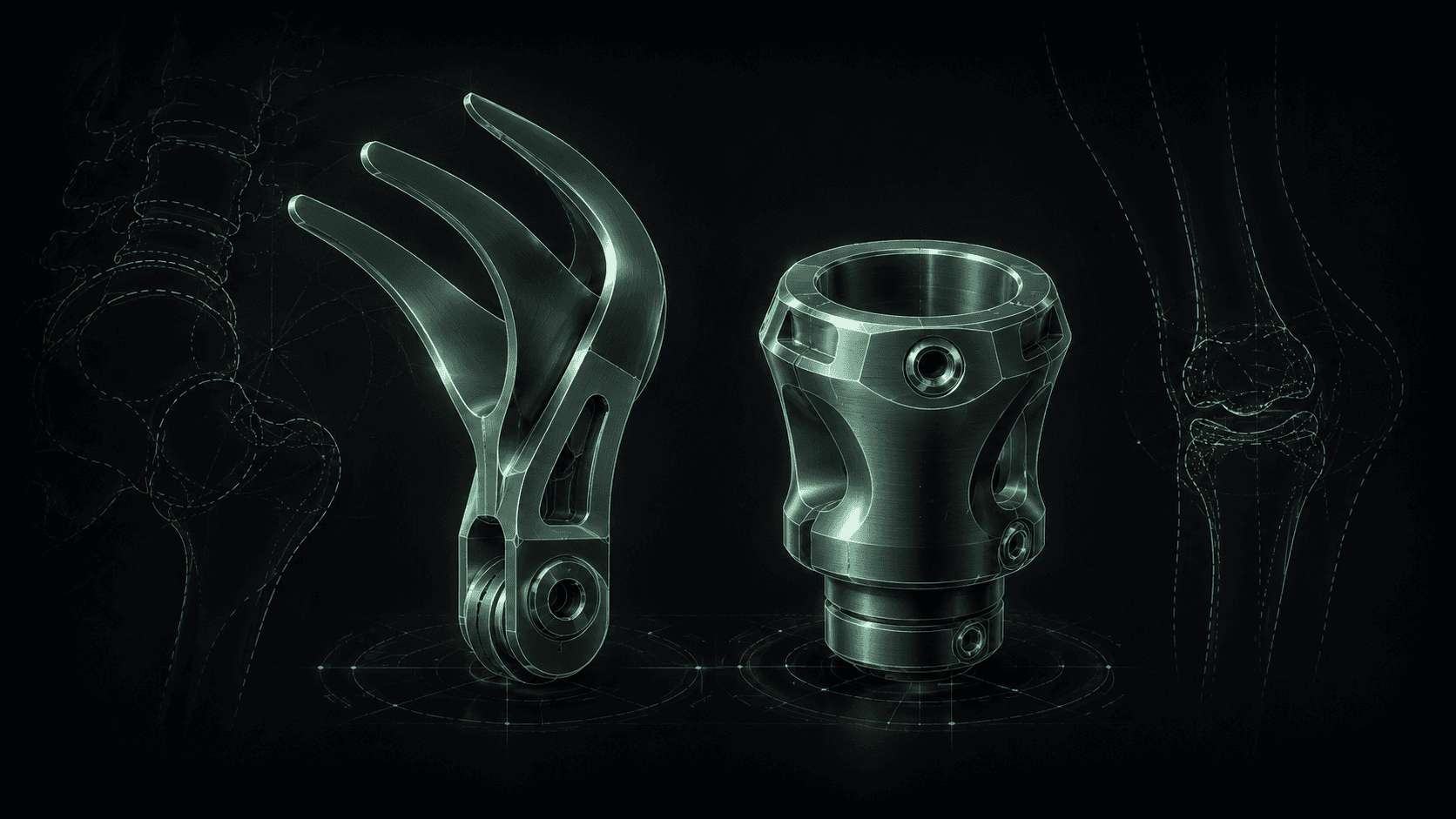
- Prosthetic and orthotic interfaces — socket adapters, alignment plates, coupling components.
- Laboratory fixtures — assay-plate holders, custom microscope stages, sample carriers.
- Wearable medical device housings — pulse-ox enclosures, patch-monitor bases, drug-delivery pump shells.
- Anatomy-matched models — patient-specific surgical guides derived from segmented CT.
Constraints we respect
- ISO 13485 documentation-friendly outputs (feature-tree lineage, parameter provenance).
- Biocompatibility-aware material choice (Ti-6Al-4V, PEEK, medical-grade nylon).
- Autoclave and sterilization survivability (min wall thickness, drainage features).
- Regulatory-relevant surface finish targets (Ra call-outs).
- Anatomical clearance envelopes when the part interfaces with tissue.
A representative workflow
A prosthetics start-up needed to iterate socket-adapter geometry across a cohort of eight patients, each with different residual-limb geometry. Traditional CAD would have been eight separate models kept in loose parallel. With SolidMake:
- Each patient's scan defined the interface surface. Everything else — the alignment plate, the coupling collar, the fastener grid — became parameterized.
- Regenerating for each patient produced a print-ready STEP and STL within minutes.
- Because the design was parametric, the team could ship a v2 across all eight patients simultaneously when the alignment collar spec changed.
Result: the socket team went from serving three trial patients per quarter to eight, without expanding their mechanical staff.
What you get, ready to use
- STEP + STL for print or machine.
- Design-history export suitable for regulatory documentation packages.
- Explicit parameter list for downstream engineering review.
- Optional generation report noting the constraints considered and the trade-offs made.