
Why robotics teams pick SolidMake
Robotics deploys iteration-hungry hardware into environments no two of which are the same. A pick-and-place cell in one factory needs a completely different gripper from the same task in the next factory. Custom mechanical isn't a nice-to-have; it's the product. SolidMake gives integrators a way to produce that custom hardware without hiring a mech-eng per customer.
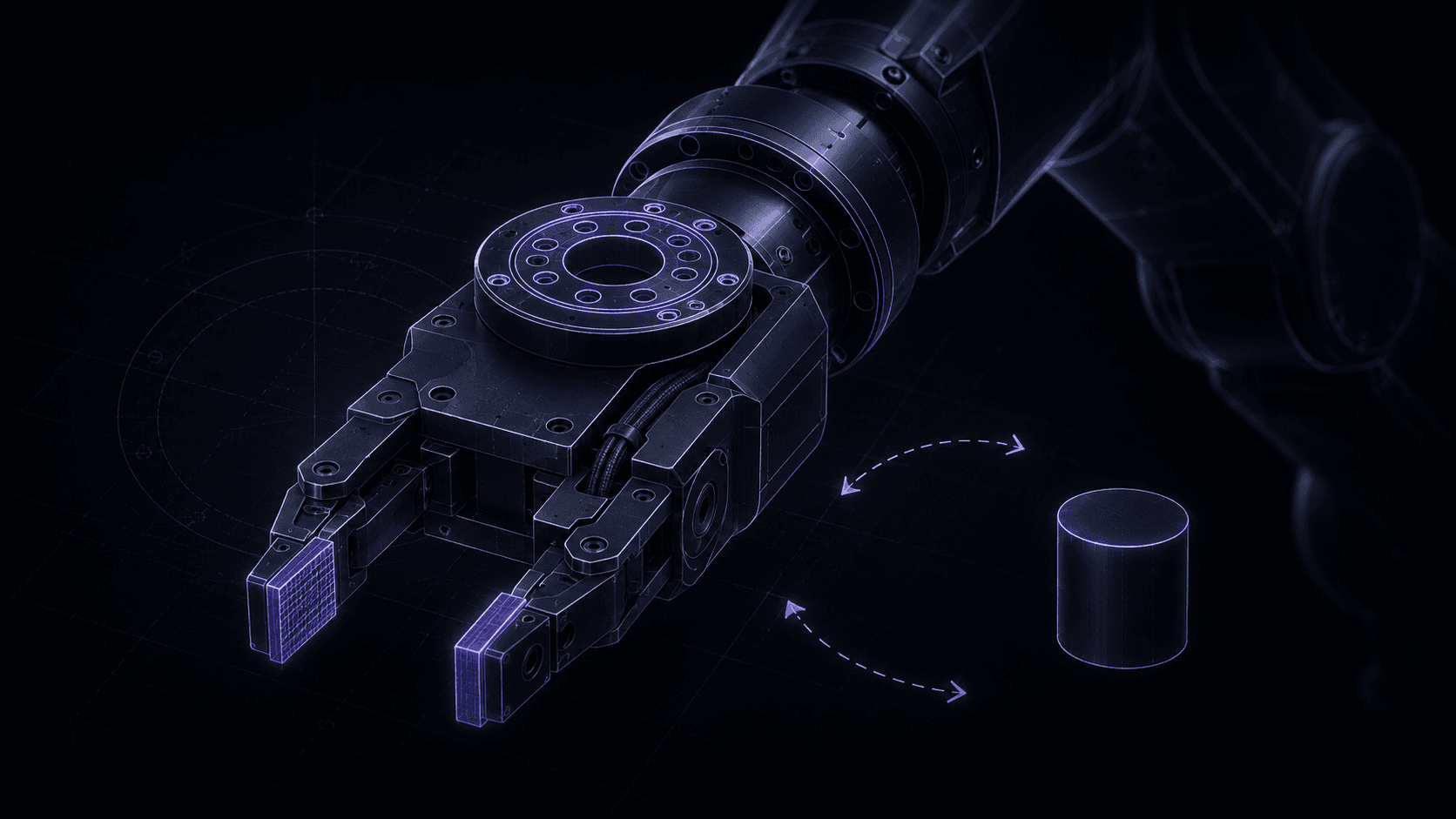
You describe the part being manipulated and the grip pose in plain English. SolidMake produces a printable two-finger gripper assembly — jaws, base, finger travel envelope, mounting flange — fully constrained to the robot's tool flange spec and the part's contact surfaces.
Parts we generate
- End-effectors — two-finger and three-finger grippers, suction plates, magnetic pickers, part-specific claws.
- Mounting hardware — tool-flange adapters (ISO 9409-1 patterns), quick-change plates, cable routing brackets.
- Structural elements — arm links, base plates, machine frames, guarding panels.
- Motion transmission — gearbox housings, pulley mounts, belt tensioners, bearing carriers.
- Sensor mounts — camera brackets, force-sensor adapters, LIDAR housings, IMU pods.
Constraints we respect
- Robot tool-flange bolt patterns (ISO 9409-1, KUKA, ABB, UR standards).
- Payload budget, moment-of-inertia budget, and reach envelope.
- Finger travel and jaw stroke for a target grip.
- Print orientation for FDM/SLS/SLA if additive; tool access if machined.
- Cable and pneumatic routing keep-outs.
- Safety-relevant edges, pinch points, and E-stop clearance.
A representative workflow
A factory-automation integrator deploys robotic pick-and-place cells into 30+ new factories a year. Each cell needs a bespoke gripper for a unique part — historically the bottleneck. With SolidMake:
- The applications engineer photographs the part, drops the photo into SolidMake, and describes the grip pose and payload.
- SolidMake proposes a printable gripper: two fingers matched to the part's contact surfaces, a base plate matching the target robot's flange, a spring return for the emergency-release.
- The engineer tweaks jaw stroke, downloads STEP, sends to the printer. The gripper is on the arm the next morning.
Result: end-effector throughput went from 12 per month to 40. Lead time from one week to one day. The team shipped more custom cells without hiring a single additional mechanical engineer.
What you get, ready to use
- Assembly-aware STEP with jaws, base, fasteners, and hardware callouts.
- STL for immediate 3D-printing.
- BOM with off-the-shelf hardware referenced (springs, dowels, fasteners).
- Print-orientation recommendation and support-material notes.
- Optional URDF stub for simulation-first workflows.