
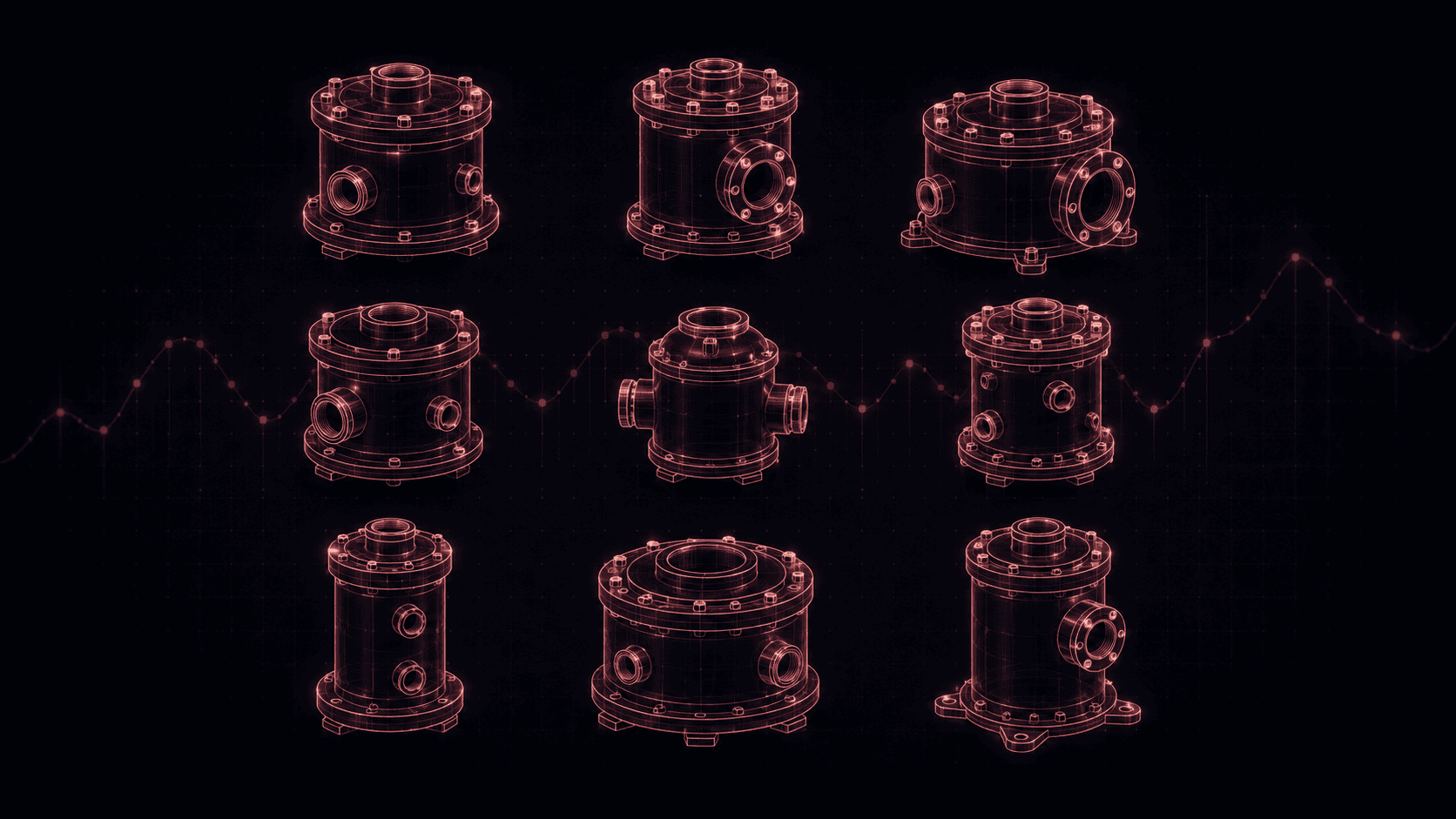
Why R&D teams pick SolidMake
Research-grade design is inherently exploratory: the whole point is to try a lot of things, compare them, and pick a direction. The CAD toolchain that produces production parts is optimized for the opposite — for single, high-fidelity, tightly-controlled artifacts. Research teams end up either exploring on the back of an envelope, or spending weeks maintaining variant families they'll throw most of away.
SolidMake was built for the exploration phase. Variants are cheap. Regeneration is atomic. Branching is a first-class operation. Nothing you build is precious.
What R&D teams do with it
- Design-of-experiments studies — sweep a parameter, generate the whole grid, measure.
- Concept downselect — twenty variants of the same subsystem, evaluated in parallel by engineering, industrial design, and manufacturability.
- Rapid-response mock-ups — turn a Monday-morning insight into a printable prototype by Tuesday standup.
- Materials studies — the same functional design in three material candidates, each geometry adjusted to that material's constraints.
- Comparative reviews — side-by-side STEP files that reviewers can open and probe individually, not slide decks with rendered images.
How the workflow feels
You describe a concept. You describe what you'd like to vary about it — chamber diameter, rib count, wall thickness, feature aspect ratio, whatever. SolidMake produces the family. Every variant is a real, machinable STEP, not a mesh. You can open any of them in any CAD tool, poke at it, take dimensions, run FEA — and if something doesn't fit, you go back to the parameters and regenerate the family in seconds.
The point isn't to replace your production CAD tool. It's to let you spend less time in that tool during the phase of the project when you don't yet know what you're building.
A representative workflow
A university lab was designing a custom pressure vessel for a novel electrochemical experiment. The pressure ratings, port arrangement, and internal geometry were all under active investigation. With SolidMake:
- The lead student described the vessel and the three parameters (chamber ID, port count, port angle) she wanted to sweep.
- SolidMake produced 27 variants in about an hour.
- The team ran quick FEA on each, downselected to three, and manufactured all three for empirical comparison.
Result: the empirical phase started three weeks earlier than the group's traditional CAD schedule would have allowed. The dissertation cited timing as a key enabling factor.
What you get, ready to use
- Family of STEP files, each fully independent and machinable.
- A tabulated parameter matrix showing what changed across the family.
- Optional side-by-side comparison view for review meetings.
- Full lineage: any variant can be re-derived from parameters, so archives stay usable.